Last Updated:
Learning Japanese on your own might seem overwhelming at first. With its unique writing systems (hiragana, katakana, and kanji), grammar rules, and pronunciation, it can definitely feel like a huge challenge. But the thing is, there are more tools and strategies available than ever to make the process manageable and fun. One of those powerful strategies is immersion.
In this guide, we'll walk you through a practical, step-by-step immersion roadmap for you to start mastering Japanese. You'll learn how to:
1. Build the foundation
2. Start consuming comprehensible input
3. Review vocabulary effectively
4. Practice with guided output
No matter whether you're an absolute beginner or an intermediate learner looking to refine your skills, this guide will improve your Japanese in an effective and efficient manner.
Before you dive into immersion, you'll need a grasp of the basics. This foundation will be what you build upon when watching and consuming Japanese content.
Japanese has three writing systems:
โ Hiragana (ใฒใใใช): used for grammar and native words
โ Katakana (ใซใฟใซใ): used for foreign loanwords
โ Kanji (ๆผขๅญ): Chinese characters used in most written Japanese
Your first step is mastering hiragana and katakana, as these are essential for reading and pronunciation. They're phonetic scripts that can realistically be learned in 1 or 2 weeks with daily practice.
Great free resources:
โ Tofugu's Hiragana Guide: https://www.tofugu.com/japanese/learn-hiragana/
โ Tofugu's Katakana Guide: https://www.tofugu.com/japanese/learn-katakana/
โ RealKana (interactive practice): https://realkana.com/
What you should aim for:
โ Instant recognition with little or no hesitation
โ Writing them from memory
โ Reading simple words smoothly
Once you can read kana (a name for both hiragana and katakana) comfortably, immersion becomes much easier.
You don't need to master advanced grammar before immersion. You just need the fundamentals:
โ Basic sentence structure (Subject-Object-Verb order)
โ Particles (ใฏ, ใ, ใ, ใซ, ใง): what they are and how they're used
โ Verb conjugations (present/past, polite/plain)
โ Basic adjectives
โ Simple sentence patterns
Excellent free resources:
โ Tae Kim's Guide to Japanese Grammar: https://www.guidetojapanese.org/grammar_guide.pdf
โ Wasabi Grammar Reference: https://wasabi-jpn.com/magazine/japanese-grammar/wasabis-online-japanese-grammar-reference/?lang=en
Make sure to focus on understanding how sentences are structured, rather than memorizing rules in isolation.
Finally, you should also know some common everyday words like:
โ ้ฃในใ (to eat)
โ ่กใ (to go)
โ ใใ (to do)
โ ่ฆใ (to see)
โ ใใ / ใใ (to exist)
Good and free vocabulary resources:
โ Core 2k/6k deck on AnkiWeb: https://ankiweb.net/shared/info/1880390099
โ JLPT vocabulary lists (N5 or N4 level): https://jlptstudy.net/N5/?vocab-list, https://jlptstudy.net/N4/?vocab-list
โ Jisho dictionary: https://jisho.org/
Remember that the goal isn't perfection but familiarity. Once you know 300 to 500 common words, immersion becomes far more effective.
Now comes both the most fun and most important part: watching and listening to Japanese content. This is where the real learning sticks, as hearing Japanese in natural conversations helps you internalize grammar, vocabulary, and pronunciation.
Current research strongly supports the importance of exposure and input in language acquisition. According to Dr. Stephen Krashen, the Input Hypothesis explains that we acquire language when we understand messages slightly above our current level. This exposure then:
โ Improves listening comprehension
โ Reinforces grammar implicitly
โ Strengthens vocabulary retention
โ Builds intuitive sentence structure understanding
This means that if you want to improve your language level, watching a lot of Japanese content will definitely help.
But here's the catch: immersion only works if you stick with it. The content that you're watching has to be something that:
โ You genuinely enjoy
โ Feels slightly challenging but understandable
โ Makes you want to watch the next episode
The easiest way to do this is to pick a show or video you already like, and simply change the audio track to Japanese. You're already interested in what it's about, so you can completely focus on comprehending and understanding what's going on.
However, this can be overwhelming, especially at first. You might lose track of what was said, making it hard to catch up and get back to where you want to be.
That's why a number of different tools exist to help make the process more fun and engaging. One such powerful tool is Sabi.
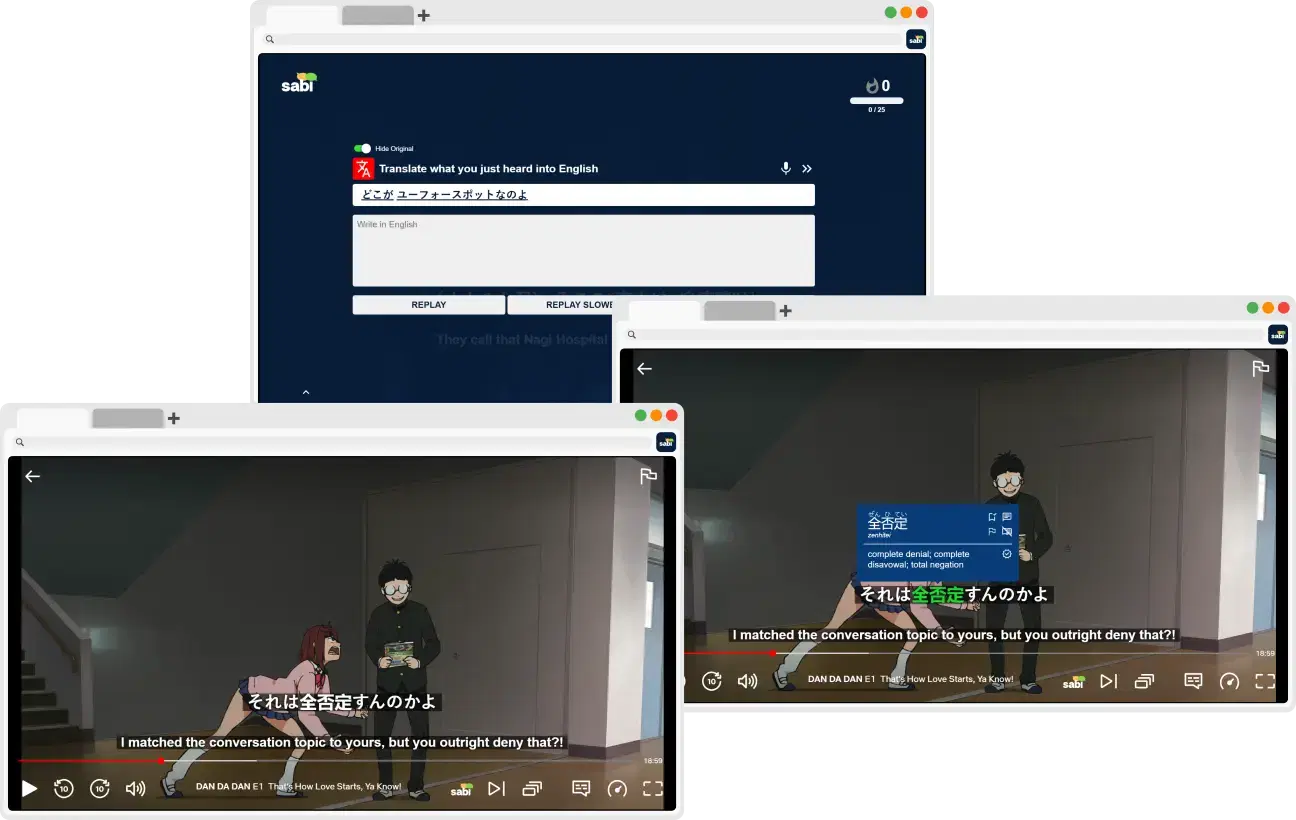
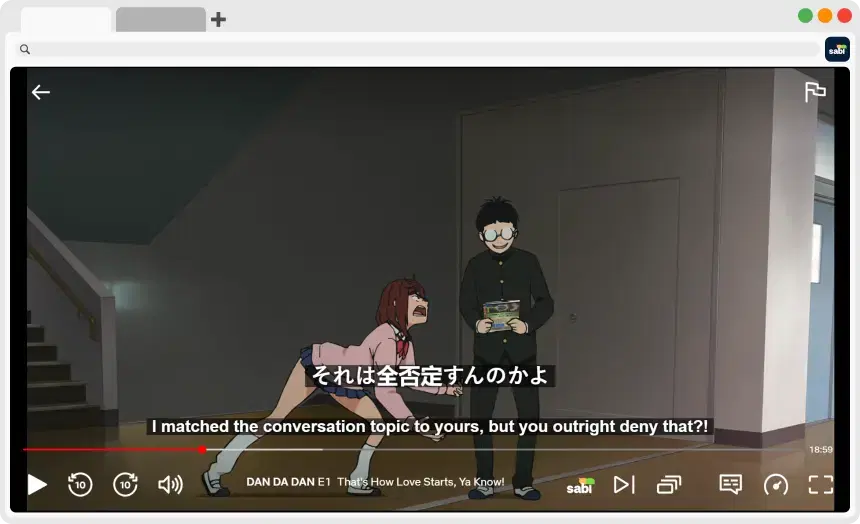
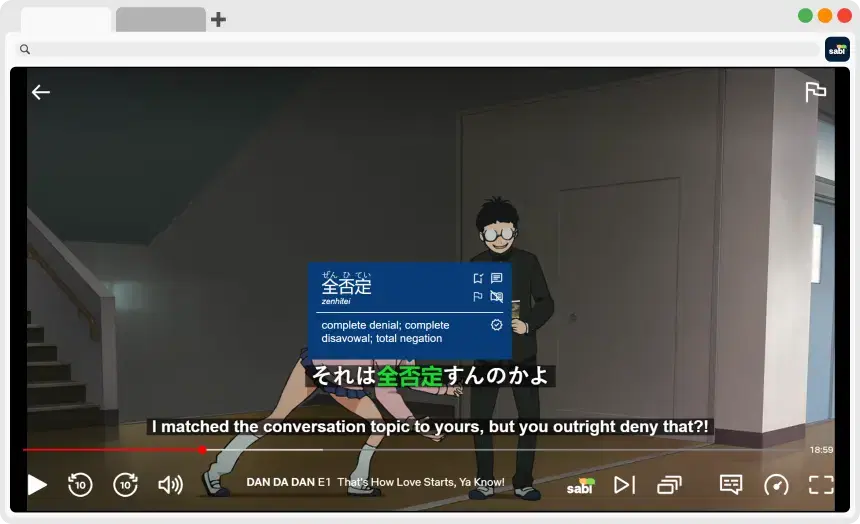
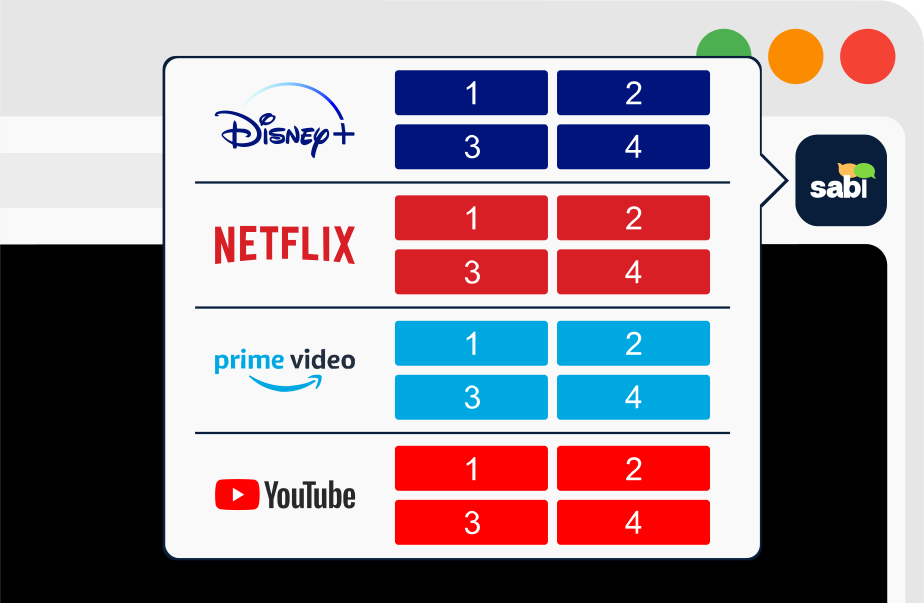
Sabi is a Chrome extension that helps you learn a language while watching directly on your favorite streaming platforms. It turns any video into a guided and interactive lesson while still being entertaining.
1. Dual Subtitles โ See Japanese and your native language subtitles together to understand context and meaning without getting lost.
2. Hover for Translations and Usage โ Hover over any Japanese word to see its meaning, pronunciation, grammar information, and sentence usage.
3. Auto-Pause After Each Subtitle โ Sabi can automatically pause after each subtitle to help your understanding and comprehension.
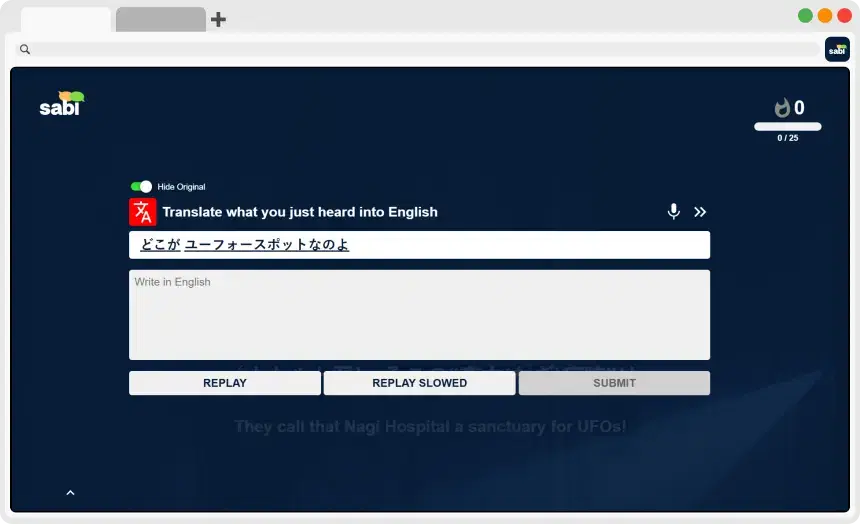
4. Interactive Exercises โ Learn and understand with different exercises while you watch.
5. AI Explain โ Get AI-powered explanations that break down grammar, conjugation, and sentence structure.
Instead of passively watching anime or dramas, you're actively learning from them. You're enjoying your favorite content in a structured and guided way.
Choosing content can be overwhelming, especially when you're not sure of what you might or might not understand. To get a better idea of what to watch, check out our recommendations:
๐ The Best Anime on Netflix for Learning Japanese
๐ The Best Movies, Shows, and YouTube Channels for Learning Japanese
Watching alone is powerful, but don't forget that reviewing afterwards is incredibly effective and will make vocabulary stick better.
When watching content, you'll encounter:
โ New words
โ Slang
โ Idioms
โ Sentence patterns
If you don't review them, you'll either forget them within days or recognize them but not know what they mean. Furthermore, research on spaced repetition shows that reviewing words at increasing intervals dramatically improves long-term retention.
The first and simplest method is by creating flashcards from the vocabulary you're learning in shows. There are many different choices for flashcard apps, but a good free one based on spaced repetition is Anki. It works through optimizing your memory retention by scheduling reviews at increasing intervals.
Here's how it works:
1. Write down new words while watching
2. Add them manually into Anki
3. Review daily using spaced repetition
This method works, but it can also be time-consuming.
When watching with Sabi, it will automatically:
โ Save words you encounter directly from subtitles
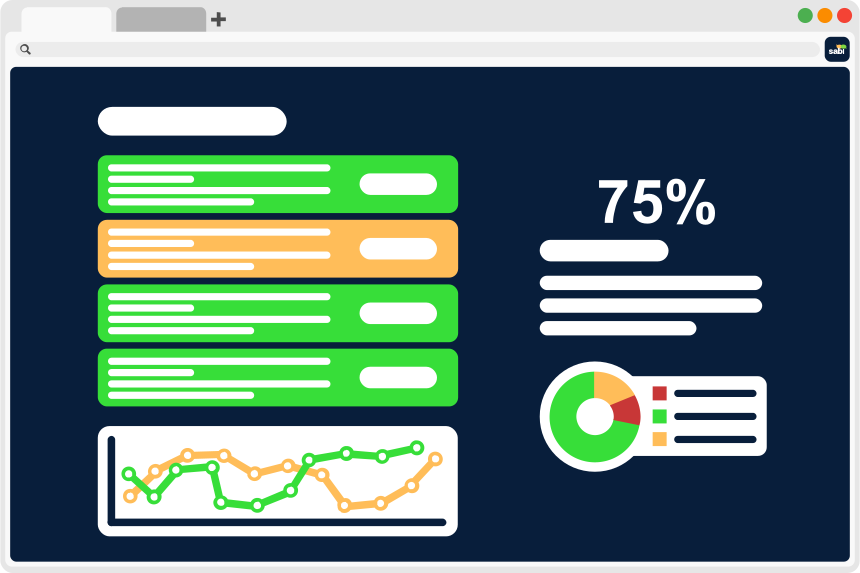
โ Track how well you know the vocabulary you've encountered
โ Provide built-in flashcard review on the Sabi website
This simplifies the process, as you no longer have to pause and manually type everything into Anki. You'll fully focus on the process of learning without any of the friction from immersion.
Once you've watched consistently and built vocabulary, it's time to actively practice producing Japanese. This is the crucial step in becoming fluent, as you're utilizing your understanding to produce comprehensible sentences. Two ways of doing this are through shadowing and sentence reconstruction.
Shadowing is one of the most powerful speaking techniques. Here's how it works:
1. Play a scene
2. Pause after each subtitle
3. Repeat exactly what was said
4. Focus on pronunciation, rhythm, and intonation
This improves:
โ Speaking confidence
โ Accent
โ Listening speed
โ Sentence flow
You can do this either manually by actively pausing after every subtitle, or automatically with Sabi. It makes the shadowing more structured and regular by:
โ Auto-pausing after subtitles
โ Giving speaking exercises where you have to repeat what was said
Sentence reconstruction involves taking a sentence in one language and translating it to another language. In this situation, that means you would be translating a sentence in your native language to Japanese. It helps you recall words and vocabulary, as well as practice applying grammar rules.
Sentence reconstruction can be done in many different ways. The easiest way is with a machine translator:
1. Write a sentence in your native language
2. Translate that sentence into Japanese
3. Input the original sentence into a machine translator like DeepL Write
4. Compare the machine translation with your translation, and adjust any errors
But you can also do it while watching a video:
1. Watch a video in your native language that has Japanese subtitles
2. Pause after a subtitle
3. Try to recreate what was said in Japanese
4. Check against the Japanese subtitles
Sabi also supports this and makes the process smoother by:
โ Giving interpretation exercises where you have to translate what was said
โ Providing AI-powered explanations that go into why your translation might not be completely accurate
โ Having review practice on the Sabi website where you are asked to translate sentences in your native language to your target language
This strengthens your active grammar usage as you're no longer just recognizing forms, but actually using them in real life.
Learning Japanese by yourself through immersion is not only possible, but also incredibly fun and rewarding. You will become fluent in just a few simple steps:
1. Build your foundation (kana, grammar, basic vocabulary)
2. Immerse with engaging, comprehensible content
3. Save and review vocabulary consistently
4. Practice guided output through shadowing and reconstruction
It's also important that you build a habit of learning Japanese rather than getting burned out within a few days. Whether you have 10 minutes or an hour a day, consistently watching, reading, and interacting with Japanese content will bring you closer to fluency.
Also, don't forget that combining structured study with immersive tools like Sabi will help you create a learning environment that's both engaging and effective. Sabi helps you make the most of your learning time, whether you're learning from anime or working through grammar exercises.
โ For Netflix Users: Read our ultimate breakdown of Language Learning with Netflix to maximize your study sessions.
โ For Viki Users: Check out our guide on Language Learning with Viki to get set up and start watching your favorite J-Dramas.
โ For Disney+ Users: Be sure to check out our article on Language Learning with Disney+ to get the most out of your favorite childhood movies.
โ For Prime Video Users: Our guide on Language Learning with Prime Video gives more tips and tricks to optimizing your content viewing.
โ For YouTube Users: Don't miss our article on Language Learning with YouTube to turn everyday videos into powerful study sessions.